
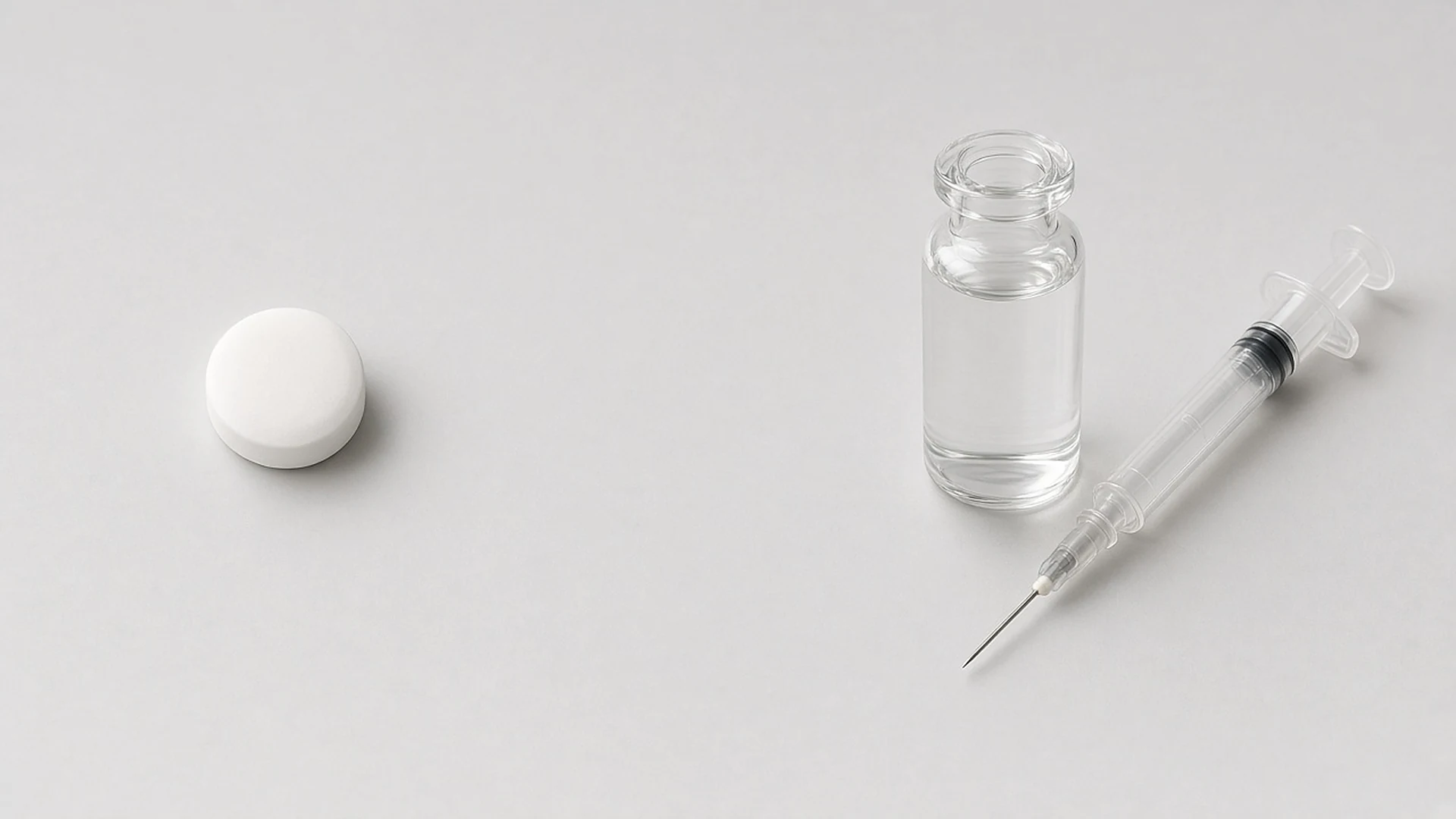
GLP-1 Pill vs Injection: Oral and Injected Semaglutide Compared
The GLP-1 pill vs injection question comes up constantly. There are now two very different things people call a "semaglutide pill." One is an FDA-approved oral semaglutide product that went through FDA's review. The other is a compounded tablet or rapid-dissolve tablet (RDT) prepared by a pharmacy, which has not. They are not interchangeable, and this article is mostly about keeping them straight.
The FDA-approved oral semaglutide product
FDA has approved an oral semaglutide tablet for chronic weight management in adults, in addition to the approved weekly injection. You can read its prescribing information on DailyMed. A few details from that labeling:
- It's taken once a day, in the morning, on an empty stomach.
- You swallow it whole with plain water, up to 4 ounces. It isn't split, crushed, chewed or dissolved.
- You wait at least 30 minutes before eating, drinking anything else or taking other oral medicines.
- Treatment starts at a low dose for 30 days and is stepped up every 30 days.
Those instructions are not a minor detail. They come from how the product was designed and studied, and they matter for how the medicine is absorbed.
How an oral peptide gets absorbed
Semaglutide is a peptide, and peptides are normally broken down in the stomach. The approved tablet includes an absorption-enhancing ingredient (salcaprozate sodium) in the tablet itself, and the labeling pairs it with the empty-stomach, small-sip-of-water routine. The labeling also describes lower and more variable blood levels with the tablet than with the injection. The injection avoids the stomach entirely: it's given under the skin once a week, and the approved schedule starts at a low dose and increases in steps.
What the trials looked at
The pivotal published trials of the approved products used the labeled doses, with lifestyle counseling, and studied each product separately. One large trial tested a 25 mg daily oral dose over more than a year. The earlier injection trial tested the weekly 2.4 mg injection. Those are different products, populations and designs, and this article doesn't compare their results, because a fair head-to-head comparison would need a trial built to make one. If you want numbers, read the papers linked below.
Compounded oral and dissolving forms: what's unstudied
Nu Image® prescribes compounded semaglutide, including in a rapid-dissolve tablet form. A compounded tablet is prepared by a licensed pharmacy for an individual patient. It is not the FDA-approved pill, it isn't a generic of it, and it isn't evaluated by FDA for safety, effectiveness or quality.
The open questions are real. A tablet that dissolves under or on the tongue is absorbed differently from a tablet swallowed whole with the approved product's enhancer. How much semaglutide a compounded dissolving tablet delivers into the blood, how consistent that is from dose to dose, and how its dosing compares with an injection haven't been established in published trials the way they have for the approved products. Nobody should assume milligram-for-milligram equivalence between a compounded tablet, the approved tablet and an injection.
Cost and access questions
Access and cost differ across the approved tablet, the approved injection and compounded options, and they change over time. Questions worth asking any provider or pharmacy: What is the total cash cost for the length of the plan? Is the medication in steady supply? Which pharmacy prepares it? Are shipping and cold-chain handling included? Ask for the answers in writing.
Who might prefer which
Preferences, not rules, tend to come down to practical things. Some people dislike needles, or travel often and find a weekly injection awkward. Others prefer the once-weekly schedule to taking something every morning on an empty stomach and waiting before breakfast and coffee. A person with a history of certain stomach conditions, or who takes several other oral medicines on a tight schedule, may have a medical reason to lean one way. Your provider weighs your history, your other medications and what's available to you. A licensed provider evaluates every patient, and product pages carry labeling and safety information for each medication.
What stays the same
Both approved products carry the same class of warnings as other semaglutide products, including the boxed warning about thyroid C-cell tumors seen in rodents and the contraindication for people with a personal or family history of medullary thyroid carcinoma or MEN 2. Nausea and other stomach-related effects are the most commonly reported with both forms, especially while the dose is being raised.
Related reading
- Compounded semaglutide
- Compounded Semaglutide and Tirzepatide: What It Actually Means
- How Long Does It Take for Semaglutide to Work? The First 12 Weeks
- Weight loss medications
Frequently asked questions
Is there an FDA-approved semaglutide pill for weight loss?
Yes. FDA has approved an oral semaglutide tablet for chronic weight management in adults. Its labeling is on DailyMed.
Is a compounded semaglutide tablet the same as the approved pill?
No. A compounded tablet or rapid-dissolve tablet is prepared by a pharmacy, isn't FDA-approved, and hasn't been shown to match the approved pill's absorption or dosing.
Why does the approved pill have such specific instructions?
Semaglutide is a peptide that the stomach would normally break down. The approved tablet pairs an absorption-enhancing ingredient with an empty-stomach, small-sip-of-water routine and a 30-minute wait.
Can I convert my injection dose to a pill dose myself?
No. Doses are not interchangeable across the injection, the approved tablet and compounded forms. Your provider decides.
Which is better, the pill or the injection?
Neither is better for everyone. They're different products with different schedules and different evidence. Your provider can help you weigh convenience, tolerability and your history.
Do the pill and the injection have the same side effects?
The most commonly reported effects are stomach-related for both, such as nausea, diarrhea and vomiting, and both carry the class warnings in their labeling.
Sources
- FDA-approved prescribing information for semaglutide injection and tablets (dosage and administration, inactive ingredients, pharmacokinetics, boxed warning), DailyMed
- Wharton S, et al. Oral Semaglutide at a Dose of 25 mg in Adults with Overweight or Obesity. N Engl J Med. 2025;393(11):1077-1087. PMID 40934115
- Wilding JPH, et al. Once-Weekly Semaglutide in Adults with Overweight or Obesity. N Engl J Med. 2021;384:989-1002. PMID 33567185
- FDA, Compounding and the FDA: Questions and Answers
Compounded medications are not FDA-approved. Prescription required; a licensed provider determines whether treatment is appropriate.
Last reviewed October 27, 2026. Reviewed by Victor Cruz, MD.
This article is for informational purposes only and does not constitute medical advice. The information contained herein is not a substitute for and should never be relied upon for professional medical advice. Always talk to your physician about the risks and benefits of any treatment. Nu Image® may not offer the medications or services mentioned in this article.